Language


Views: 256 Author: SONICNY Publish Time: 2026-11-04 Origin: Site


Content Menu
● Trolley Speaker vs Battery Powered Speaker: What Is the Difference?
● Which Speaker Is Better for Mobile DJs?
>> Choose for the Performance, Not the Feature Count
>> Keep the Main DJ Audio Connection Predictable
● Which Speaker Is Better for Event Rental Companies?
● Battery Runtime: Compare Test Conditions, Not Just Hours
>> Request a Usable Battery Test Report
>> Build a Runtime Plan Around the Whole Booking
● Sound Output and Coverage: Look Beyond Advertised Watts
>> Avoid Universal Audience-Size Promises
● Three Practical Buying Scenarios
>> Scenario 1: A Wedding Ceremony Away from Mains Power
>> Scenario 2: A Mobile DJ Hosting a Dance Party
>> Scenario 3: A Rental Fleet Serving Mixed Small Events
● A Five-Step Sample Acceptance Test
● Calculate Rental Value Beyond Purchase Price
● Working with SONICNY on Your Speaker Requirements
>> Is a trolley speaker always battery-powered?
>> Can a battery-powered speaker have wheels?
>> Are trolley speakers suitable for professional mobile DJs?
>> How much battery life should an event rental speaker provide?
>> Is Bluetooth suitable for live DJ mixing?
>> Does a higher wattage rating mean better sound?
>> What should buyers request before a bulk order?
Guangzhou Kanian Electronic Co., Ltd., the company behind SONICNY, is a speaker manufacturer based in Huadu, Guangzhou, China. We develop and produce Bluetooth speakers, party speakers, and home audio products for customers worldwide. Our goal is to build long-term partnerships as a dependable speaker manufacturing partner in China.
When discussing "Trolley Speaker vs Battery Powered Speaker for Mobile DJs and Event Rental Companies," we start with one important distinction: these are not necessarily competing categories. A trolley speaker describes how a speaker moves. A battery-powered speaker describes how it receives power. One product can be both.
For professional buyers, the real question is suitability: which design delivers the required sound, operating time, connectivity, and serviceability for your events?
This guide approaches that decision from a manufacturing and procurement perspective, without assuming that wheels, battery size, or advertised watts automatically determine professional performance.

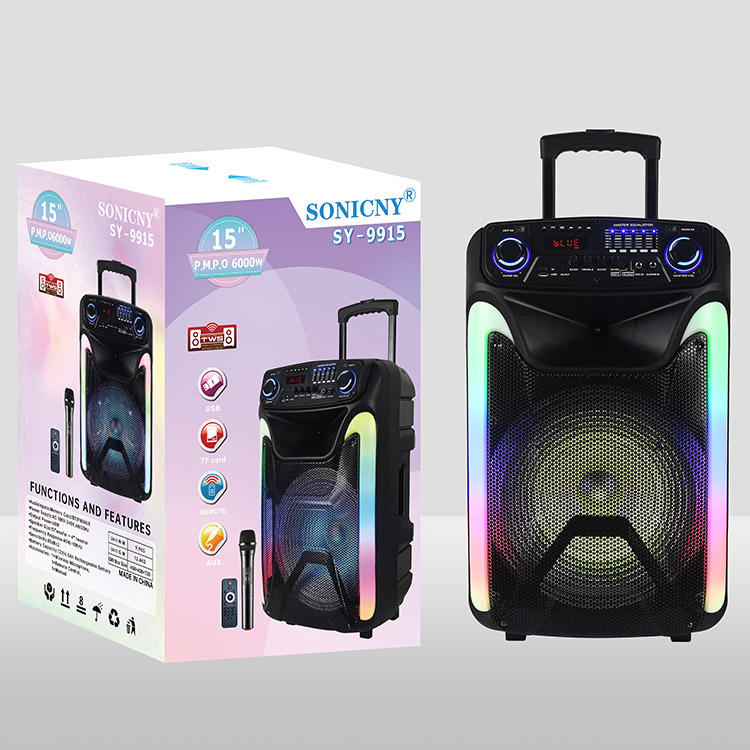
A trolley speaker normally incorporates wheels and a pull handle. Depending on the model, it may include a rechargeable battery, microphone inputs, Bluetooth playback, lighting, or media controls.
A battery-powered speaker operates from an internal or removable battery. It may use a carry handle, wheels, or a separate transport cart.
A third term also needs clarification: an active or "powered" speaker has an integrated amplifier, but it does not necessarily contain a battery.
| Buying factor | Trolley speaker | Battery-powered portable PA |
|---|---|---|
| Defining characteristic | Integrated transport features | Battery operation |
| Mobility | Rolling transport where surfaces allow | Carrying, rolling, or separate cart |
| Power supply | Model-dependent | Battery; mains operation may also be available |
| Audio connections | Must be verified individually | Must be verified individually |
| Best starting question | Can staff move it safely and efficiently? | Can it complete the event at the required output? |
| Potential overlap | May also be battery-powered | May also have trolley wheels |
Neither label guarantees better sound. Compare individual products against the same event requirements.
*[Image suggestion: Show a wheeled speaker beside a carry-handle battery PA, with labels identifying transport features, battery access, and audio inputs.]*
For mobile DJs, we would prioritize the complete signal path and acoustic requirements before choosing a cabinet style.
A speaker suitable for background music may not deliver the sustained low-frequency output required for dancing. Similarly, a convenient party speaker may lack the connections or controls needed for a DJ controller and separate microphones.
Check:
- Compatible line-level inputs for your controller.
- Independent microphone and music adjustment.
- Output connections for additional speakers.
- Published maximum sound pressure level and measurement conditions.
- Frequency-response limits and measurement tolerances.
- Battery performance at realistic music levels.
Do not assume that a larger woofer or a larger wattage claim settles the comparison.
Bluetooth is convenient for background playlists. For beatmatching and other timing-sensitive performance, a wired connection is generally the safer starting point because Bluetooth can introduce noticeable delay.
Check the entire playback chain during rehearsal. A wired controller connection does not eliminate delays introduced elsewhere by processing or wireless speaker links.
For a dance-focused event, also evaluate whether the system needs a separate subwoofer. Battery operation alone does not establish that a speaker can deliver the bass output your audience expects.
Rental companies should evaluate how equipment performs across repeated bookings, different operators, and imperfect handling.
A trolley design can simplify transport along suitable paved routes. However, wheels are less helpful on stairs, loose gravel, or soft ground. A compact carry-handle unit may be easier in some venues, while a heavier system may require two-person handling.
Inspect the practical details:
- Wheel attachment and replaceability.
- Handle strength and stability.
- Access to charging connections.
- Protection for knobs, sockets, and controls.
- Battery replacement procedure.
- Availability of compatible chargers and spare parts.
- Clear operating instructions for rental customers.
We would treat easy handover as a buying criterion. A customer who can identify microphone volume, music volume, and battery status quickly is less likely to need avoidable support.
Battery life is one of the easiest specifications to misunderstand.
"Up to 12 hours" does not mean 12 hours of bass-heavy music at the highest usable output. Manufacturers may state different operating times for moderate playback and demanding performance.
For example, Electro-Voice specifies more than 12 hours for the EVERSE 8 at an average 95 dB SPL with typical program material, versus more than six hours at maximum output before limit indication. Bose lists up to 11 hours for the S1 Pro+, while its support guidance explains that content, volume, temperature, connected devices, and battery age affect results.
These examples illustrate why headline runtime figures should not be compared without their conditions.
Ask the supplier to identify:
1. Battery capacity in watt-hours.
2. Playback material.
3. Volume, EQ, and operating mode.
4. Measured sound level and measurement position.
5. Whether lights, microphones, and charging outputs were active.
6. Test endpoint and remaining-charge indication.
7. Ambient temperature and battery condition.
Watt-hours describe stored energy more usefully than amp-hours alone when battery voltages differ. Even then, capacity does not independently establish runtime; operating demand also matters.
Include setup, soundcheck, waiting time, announcements, and music playback.
As an illustrative internal policy—not a universal standard—a rental company might require a 25% operating-time reserve. A four-hour deployment would therefore need five hours of demonstrated usable runtime under representative conditions.
The important word is demonstrated. Test the actual configuration rather than relying only on the packaging.
Amplifier wattage is not a complete measure of useful acoustic output. Speaker efficiency, processing, distortion, and limiting also affect the result.
Maximum SPL is more relevant to loudness, but comparisons still require care. Ask whether the figure is measured or calculated, peak or sustained, and at what distance.
Coverage matters just as much. A speaker can sound loud near the cabinet while leaving listeners elsewhere struggling to hear speech.
"How many people can this speaker cover?" is useful only when the event conditions are defined.
A procurement brief should identify:
- Speech, background music, or dance music.
- Indoor or outdoor location.
- Audience layout and listening distance.
- Background noise.
- Required bass performance.
- Speaker placement and permitted sound levels.
A seated presentation and an outdoor dance event with the same attendance are different audio assignments. Do not turn one successful demonstration into a universal capacity claim.
The following are hypothetical procurement examples, not customer testimonials or verified SONICNY case studies.
Priorities include clear speech, straightforward microphone operation, discreet placement, and sufficient runtime for delays.
A compact battery-powered PA may be convenient. A trolley model can also work if its placement, appearance, inputs, and speech performance suit the venue.
Test microphone intelligibility at the furthest seating position.
Priorities shift toward sustained music output, bass performance, controller connectivity, and system expansion.
Do not choose solely because a speaker has wheels, lighting, or a high advertised power figure. Confirm that the complete system meets the performance requirement, whether battery-powered or mains-powered.
Consistency may matter more than an extensive feature list.
Standardized controls, chargers, accessories, and handover procedures can simplify operations. Before committing to one platform, verify that batteries and replacement parts are genuinely compatible across the proposed models.
Before placing a bulk order, convert the intended use into a repeatable acceptance procedure.
1. Define the job. Record the event duration, sources, listening area, transport route, and expected operating conditions.
2. Test the connections. Use the actual controller, microphone receiver, cables, and additional speakers.
3. Run representative audio. Include speech, typical playlists, and demanding tracks without deliberately operating beyond safe limits.
4. Record performance. Log settings, sound-level measurements, battery behavior, charging time, and any interruptions.
5. Inspect after use. Check wheels, handles, connectors, controls, and packing condition.
Agree on pass/fail criteria before testing. Keep the sample's configuration and results with the purchase specification so later deliveries can be checked against the same requirements.
The cheapest speaker is not automatically the least expensive rental asset.
A practical comparison includes:
Total ownership cost = purchase price + accessories + maintenance + replacement batteries + repair costs + attributable downtime costs.
For an illustrative calculation, a system costing $600 and generating $40 per hire after direct operating costs would require 15 hires to recover its purchase price alone. That is not a profit forecast: overhead, maintenance, taxes, and other costs still need consideration.
Ask suppliers about battery availability, repair procedures, warranty exclusions, and replacement-part lead times before ordering.
For outdoor work, verify the exact weather-resistance conditions. For example, the EVERSE 8's stated IP43 protection depends on using its weatherized input cover during battery-powered Bluetooth operation. Do not assume a similar rating applies to another speaker or every connection arrangement.
At Guangzhou Kanian Electronic Co., Ltd., our focus is the development and production of Bluetooth, party, and home speakers for international customers.
Our recommended starting point is a clear application brief—not a request for the "loudest" speaker.
Share your:
- Target customers and event types.
- Required operating time and playback level.
- Preferred dimensions, weight, and transport format.
- Microphone, controller, and playback connections.
- Destination market and documentation requirements.
- Order quantity and after-sales expectations.
Contact SONICNY to discuss these requirements and request information about available models, samples, and applicable test documentation. Confirm specifications, certifications, customization options, and commercial terms for the particular product before purchase.
No. "Trolley" describes transport features. Check whether the individual model supports battery operation, mains operation, or both.
Yes. Battery operation and wheeled transport are compatible features. Buyers do not necessarily need to choose between them.
Some may be. Suitability depends on sound output, bass performance, connections, controls, and reliability—not the trolley format itself.
It should cover the complete deployment, including preparation and delays, with an agreed reserve. Validate runtime using representative audio and settings.
It is convenient for casual playback, but delay can interfere with timing-sensitive performance. A tested wired connection is generally preferable for the main controller output.
No. Consider acoustic output, distortion, frequency response, coverage, and measurement conditions alongside amplifier specifications.
Request model-specific specifications, sample-test results, battery conditions, applicable compliance documentation, warranty terms, and spare-part information.
- Company information: User-supplied introduction identifying SONICNY / Guangzhou Kanian Electronic Co., Ltd., its Guangzhou Huadu location, product focus, international sales, and partnership objectives. No customer reviews or model-specific performance data were supplied.
- JBL Professional, "EON ONE Compact": manufacturer information on rechargeable operation and stated battery life. [jblpro]
- Bose Support, "Short battery life — S1 Pro+": manufacturer guidance on runtime variability and performance-volume expectations. [support.bose]
- Electro-Voice, "EVERSE 8": manufacturer specifications covering runtime test conditions, maximum SPL, coverage, and conditional IP43 protection. [products.electrovoice]
- Electro-Voice, "EVERSE 8 Engineering Data Sheet": technical specifications and battery-performance conditions. [products.electrovoice]
- DJ City, "Bluetooth Speakers": specialist retail guidance distinguishing powered speakers from battery-powered speakers and discussing wired connections for latency-sensitive DJ use. [djcity.com]
- Editorial analysis: The procurement scenarios, acceptance workflow, reserve policy, and cost example are recommendations or explicitly hypothetical illustrations, not published customer outcomes.
Hot Tags: China, Global, OEM, private label, manufacturers, factory, suppliers, manufacturing company