Language


Views: 270 Author: SONICNY Publish Time: 2026-11-03 Origin: SONICNY


Content Menu
● Active Speaker System vs Passive Speaker System: What Is the Difference?
>> Active Speakers Integrate Amplification
>> Passive Speakers Use External Amplifiers
● Commercial Audio System Comparison at a Glance
● Which System Fits Your Commercial Installation?
>> Restaurants, Retail Stores, and Hotels
>> Fitness Studios, Training Rooms, and Event Spaces
>> Permanent, High-Output Music Venues
● Why 70V/100V Audio Changes the Comparison
>> An Illustrative Amplifier-Sizing Example
● Sound Quality: Compare Coverage Before Wattage
>> Why More Speakers Can Be Better Than Louder Speakers
● Compare Total Installed Cost, Not Speaker Price
>> Costs Commonly Missed in Active Systems
>> Costs Commonly Missed in Passive Systems
● Maintenance and Reliability: Plan for Failure Before Purchase
● Two Illustrative Commercial Audio Scenarios
>> Scenario 1: A Multi-Zone Café
>> Scenario 2: A Flexible Fitness Studio
● A Seven-Step Specification Checklist for Buyers
● Work with Guangzhou Kanian Electronic Co., Ltd. on a Clear Product Brief
>> Request a Project-Focused Manufacturing Discussion
>> 1. Are active speakers better than passive speakers for commercial installations?
>> 2. Do passive speakers need an amplifier?
>> 3. Are 70V/100V speakers the same as ordinary passive speakers?
>> 4. Can Bluetooth speakers replace a permanent commercial audio system?
>> 5. Which system is easier to maintain?
>> 6. Can active and passive speakers work in the same installation?
Guangzhou Kanian Electronic Co., Ltd., the company behind SONICNY, is a speaker manufacturer based in Huadu, Guangzhou, China, focused on developing and producing Bluetooth speakers, party speakers, and home audio speakers for global markets. For buyers researching Active Speaker System vs Passive Speaker System for Commercial Audio Installations, the most useful starting point is not a product specification. It is how the complete system will operate, expand, and be maintained.
From a manufacturer's perspective, choosing a speaker means looking beyond its enclosure. Amplification, wiring, coverage, electrical access, and service arrangements all influence the result.
This guide explains those trade-offs and provides a practical framework for discussing your requirements with a manufacturer or installation professional.
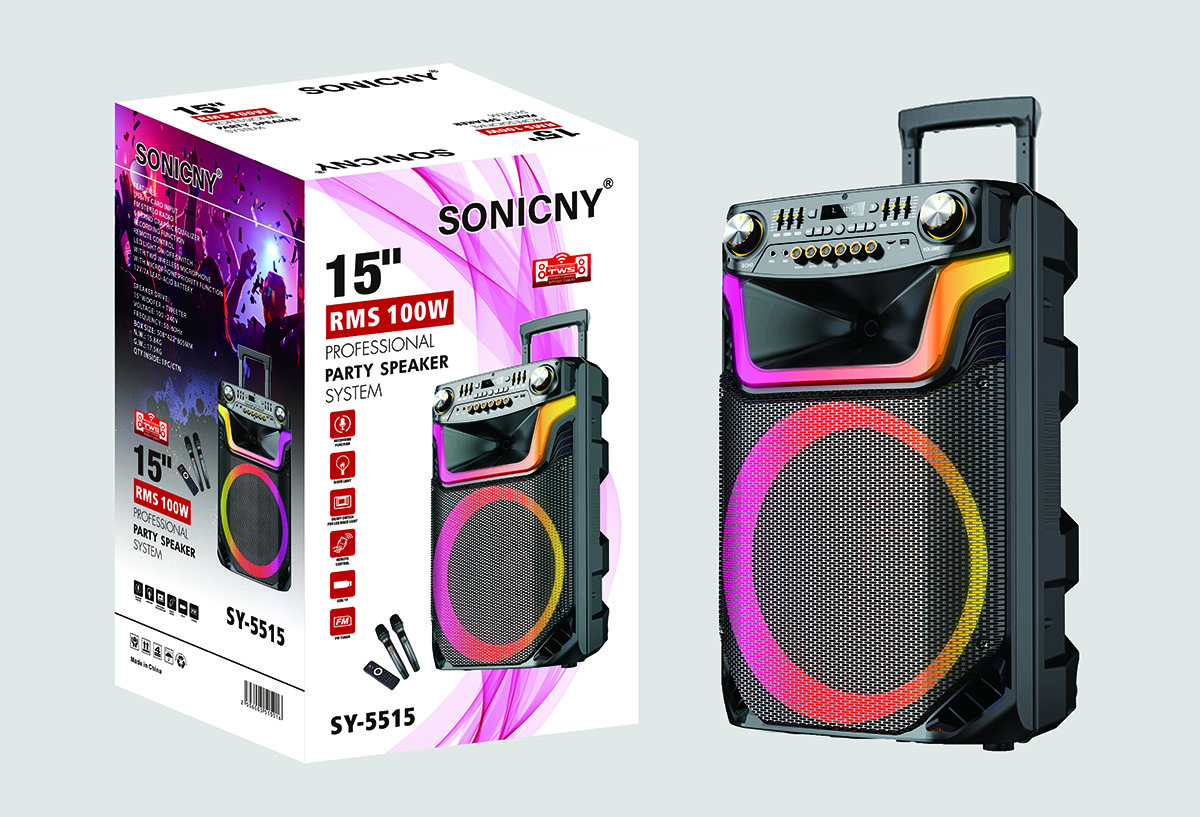
An active—or powered—speaker incorporates amplification inside its enclosure. It receives an audio signal and requires a suitable electrical supply.
Many powered professional speakers also include digital signal processing, or DSP. Depending on the model, this can provide equalization, crossover functions, limiting, and alignment controls.
An important technical distinction: "powered" describes amplifier location, while "active crossover" describes how frequency bands are divided before amplification. These terms often overlap in product descriptions, but they are not strictly identical.
For this guide, "active speaker" means a powered loudspeaker with built-in amplification.
A passive speaker receives an amplified signal from an external amplifier through speaker cable.
A conventional passive multiway enclosure typically uses an internal passive crossover to distribute frequencies between its drivers. Some professional loudspeakers also support externally processed, bi-amplified configurations.
Passive commercial systems commonly use either:
- Low-impedance connections, such as 4, 8, or 16 ohms.
- Transformer-equipped 70V or 100V distribution.
These configurations solve different installation problems. Passive does not automatically mean 70V/100V, and active does not automatically mean wireless.
| Decision factor | Active speaker system | Passive speaker system |
|---|---|---|
| Amplification | Built into the speaker | Located in an external amplifier |
| Power requirements | Electrical power at each powered location | Electrical power at amplifier locations |
| Signal distribution | Typically line-level or supported digital audio | Amplified audio through speaker cable |
| Processing | Often integrated; capabilities vary | Commonly provided by external DSP or amplifiers |
| Distributed background music | Possible, but infrastructure needs careful planning | 70V/100V designs often suit many-speaker layouts |
| Maintenance | Electronics may require access to the speaker | Amplifiers can be serviced centrally |
| Expansion | Depends on power, signal routing, and control | Depends on amplifier capacity, impedance, and zoning |
| Best starting point | Localized, flexible sound reinforcement | Distributed coverage or centralized equipment management |
Neither architecture guarantees better sound. Speaker quality, placement, acoustics, and commissioning remain decisive.
For background music across multiple rooms, a passive 70V/100V system is often a practical starting point.
Transformer-equipped speakers can be connected in parallel, with individual power taps helping allocate output across different areas.
However, speaker taps do not create independent audio zones. Separate music sources or independently controlled areas require appropriate amplifier channels, routing, and controls.
A restaurant may need quiet dining coverage, stronger bar playback, and separately controlled outdoor audio. Those requirements should be mapped before selecting speakers.
Active speakers can be attractive when a room needs concentrated output and accessible local control.
Integrated amplification and processing can reduce the number of separate components required. This is useful where equipment is repositioned or where a relatively small number of speakers covers the space.
The limitation is infrastructure: every powered speaker location needs suitable power and a dependable audio connection.
Both architectures can work for performance-oriented installations.
Powered professional systems can provide integrated processing and matched amplification. Passive systems can support centralized amplification and processing.
The better choice depends on required output, mounting positions, service access, and the installer's system design—not simply whether an amplifier is inside the cabinet.
Many buying guides overlook the difference between distributed audio and conventional low-impedance systems.
A 70V/100V installation uses compatible amplifiers and transformer-equipped speakers. This allows many loudspeakers to share an amplifier circuit without treating the installation like a collection of ordinary low-impedance loads.
The term "constant voltage" does not mean that a fixed voltage is continuously present. The audio voltage changes with the signal.
Imagine twelve ceiling speakers, each set to a 10W transformer tap:
12×10W=120W
The connected tap total is 120W.
That does not automatically make a 120W amplifier the correct purchase. The selected amplifier should exceed the connected load and satisfy its manufacturer's loading guidance, operating conditions, and project requirements.
Also verify:
- Amplifier and speaker voltage compatibility.
- Cable length, conductor size, and acceptable losses.
- Transformer bandwidth for the intended music.
- Required zones and future expansion.
- Any applicable emergency-audio requirements.
For low-impedance systems, amplifier selection instead requires careful consideration of load impedance, speaker ratings, wiring, and processing.
A high wattage figure does not explain how evenly customers will hear music or understand speech.
For commercial sound system design, compare:
1. Coverage angle and listening distance.
2. Required sound pressure level.
3. Speech intelligibility.
4. Frequency response and bass requirements.
5. Distortion at the intended operating level.
6. Consistency between adjacent listening areas.
An active speaker's integrated processing can simplify setup, but it cannot compensate for poor placement.
Likewise, passive speakers can perform exceptionally well when amplification, processing, and installation are properly matched.
In a long restaurant or irregular retail space, several appropriately positioned speakers may provide more even coverage than two loud speakers at one end.
However, additional speakers also introduce interactions. Coverage overlap, reflections, and timing must be managed.
The objective is consistent listening conditions—not simply the largest speaker count.
*Suggested visual: A floor-plan comparison showing uneven coverage from two front-mounted speakers versus distributed coverage from several correctly positioned speakers.*
The cheapest enclosure may produce the more expensive installation.
Use this project-level comparison:
Total installed cost = loudspeakers + amplification + processing + cabling + electrical work + mounting + commissioning.
Then evaluate operating and maintenance costs separately.
- Electrical outlets at elevated or remote positions.
- Signal distribution and cable management.
- Access equipment for servicing mounted electronics.
- Network configuration where networked audio is used.
- Amplifiers, DSP, and equipment racks.
- Rack ventilation and suitable electrical supply.
- Speaker cable and installation labor.
- Load calculations and system configuration.
Avoid generic claims that one architecture always saves a particular percentage. Meaningful savings require comparable designs and actual quotations.
Every commercial installation needs a service strategy.
With passive speakers, centralized amplifiers can be accessible for replacement. However, one amplifier failure may affect several speakers or an entire zone.
With active speakers, an amplifier fault may be localized to one enclosure. Yet reaching that enclosure could require a lift, restricted access, or downtime.
Neither design is automatically more reliable.
Ask these questions during procurement:
- Can staff identify a failed zone quickly?
- Are replacement products or modules available?
- How long is the expected service turnaround?
- Can the system continue operating at reduced capacity?
- Who maintains configuration files and commissioning records?
For business-critical applications, assess redundancy and fault containment with the system designer.
A café needs background music in dining areas, a corridor, and a patio.
A passive distributed system may simplify speaker wiring and centralize equipment. Separate amplifier channels or suitable zone controls can support different operating levels.
The patio adds another requirement: environmental suitability. Neither an active nor a passive label establishes weather resistance.
The buyer must verify the specific model's environmental rating, mounting hardware, and installation instructions.
A studio needs instructor speech and energetic music, with speakers positioned near accessible electrical outlets.
An active system may reduce separate rack equipment and simplify local setup.
However, microphone feedback, room reflections, bass distribution, and operator controls still need attention.
These scenarios are planning examples, not SONICNY customer case studies or performance guarantees.
Before requesting a commercial audio quotation, prepare the following:
1. Describe the space: provide dimensions, ceiling height, layout, and mounting restrictions.
2. Define the use: distinguish background music, speech, fitness instruction, and live entertainment.
3. Map the zones: identify areas needing separate sources, levels, or schedules.
4. Confirm infrastructure: document electrical access, cable routes, rack space, and network availability.
5. Set performance targets: specify coverage and listening expectations rather than wattage alone.
6. Define compliance requirements: confirm destination-market and project-specific obligations.
7. Agree on acceptance testing: include coverage checks, control operation, documentation, and handover.
If the installation carries emergency announcements, consult qualified specialists. Ordinary commercial music equipment should not be assumed suitable for regulated life-safety use.
*Suggested video: A short commissioning walkthrough demonstrating zone controls, speech checks, and normal operating levels.*
SONICNY emphasizes long-term partnerships and aims to become a dependable speaker manufacturing partner in China.
For commercial buyers, that relationship should begin with transparent requirements—not assumptions that every Bluetooth, party, or home speaker is installation-ready.
When discussing a potential product with Guangzhou Kanian Electronic Co., Ltd., share the intended application, destination market, quantity, connectivity, mounting needs, and documentation requirements.
Request model-specific confirmation of performance, electrical characteristics, available testing, and suitability for the proposed use.
Send Guangzhou Kanian Electronic Co., Ltd. your room layout, application, target budget, and initial order requirements.
Ask the SONICNY team to identify which available products—or development discussions—could fit your brief, with clear specifications and agreed evaluation criteria before purchasing.
Not universally. Active speakers can simplify localized systems, while passive designs can support centralized amplification and distributed coverage. Installation requirements determine the better fit.
Yes. Passive speakers require an external power amplifier. The amplifier must match the speaker configuration, load, and intended operating conditions.
They are a type of passive speaker configuration, typically incorporating transformers for distributed audio. Not every passive speaker supports 70V/100V operation.
Not automatically. Bluetooth describes connectivity, not installation suitability. Verify coverage, controls, mounting, electrical requirements, and operational reliability for the specific application.
Passive systems often centralize amplifier servicing. Active systems distribute amplification among enclosures. Actual maintenance difficulty depends on access, spare parts, system layout, and support arrangements.
Yes. A project can combine powered reinforcement speakers with passive distributed zones. Appropriate signal routing, level management, processing, and commissioning are essential.

- Company background and positioning: Information supplied by Guangzhou Kanian Electronic Co., Ltd./SONICNY for this article. No independent company certifications, customer reviews, or completed installation claims were supplied.
- Yamaha, "[Better Sound for Commercial Installations: High-impedance and Low-impedance Connections]." Technical basis for 70V/100V distribution, transformer loads, amplifier compatibility, and low-impedance connections. [usa.yamaha]
- Yamaha, "[VC Series—Commercial Installation Speakers]." Manufacturer examples of commercial ceiling speakers supporting high- and low-impedance connections. [usa.yamaha]
- JBL Professional, "[SRX906LA Powered Line Array Loudspeaker]." Manufacturer example of powered professional loudspeakers intended for applications including fixed installations. [jblpro]
- JBL Professional, "[SP212-A: Two-Way Full-Range Loudspeaker System for Permanent Installation]." Technical example distinguishing passive-crossover operation from externally processed bi-amplified operation. [jblpro]
Hot Tags: China, Global, OEM, private label, manufacturers, factory, suppliers, manufacturing company